At a Glance
Rattail, Hanoverian, and Old English are the oldest English flatware patterns, each subtly distinct
Old English (from 1760) is the most restrained pattern — usually held as genuine Georgian or Edwardian revival stock
Fiddle (from 1739) is the most influential pattern — forks and spoons curve in opposite directions
Fiddle & Thread is ~30% heavier than plain Fiddle; regimental examples often show heavy wear
Fiddle, Thread & Shell (from 1810) is still made today — formal, but suited to everyday use
King’s and Queen’s Shape reflect the more elaborate Regency era, with many named variants
More than 50 years’ experience sourcing complete and part-services
Style & Maker History
Among the oldest patterns in English flatware are Rattail, Hanoverian, and Old English — similar at a glance, but each genuinely distinct. Rattail takes its name from the ‘spine’ running down the front of the spoon and the corresponding ‘tail’ on the back of the bowl. Hanoverian arrived a little later, with the German-born George I’s accession to the English throne — plainer than Rattail, and originally three-tined before settling into the now-familiar four. Old English followed in the reign of George III, from 1760 onwards: four tines, an abbreviated version of the spine known as the ‘pip,’ and no tail or ‘lug’ on the reverse. It’s generally considered the most restrained and elegant of the antique English flatware patterns.
Fiddle is arguably the most influential English flatware pattern of all. Its earliest possible ancestor is a piece in the Esquiline Treasure, a late Roman hoard held in the British Museum. The pattern emerges in British silver in 1739 and becomes almost ubiquitous by 1800. Fiddle always has four tines, a lug, and a pip, along with distinctive ‘shoulders’ and a fiddle-shaped body at the base — and forks and spoons in a Fiddle service curve in opposite directions, a nod to the different ways French and English tables were traditionally laid.
Fiddle & Thread, a variant that typically adds around 30% to the weight of a full service, developed in the 1790s and reached peak popularity around 1810 to 1815. Fiddle, Thread & Shell goes further still, combining Fiddle & Thread with Fiddle & Shell for an even heavier service. It emerged in 1810 and remains in production today.
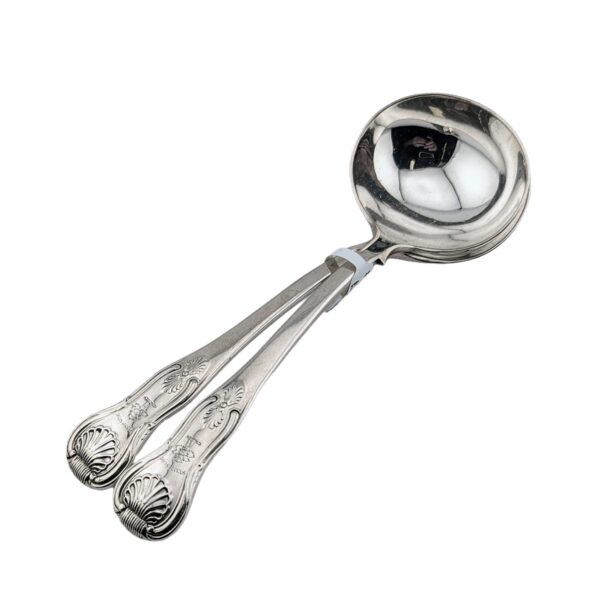
King’s Shape and Queen’s Shape belong to a later, more elaborate moment: as disposable incomes rose through the Regency period, tastes in silver grew correspondingly more ornate. King’s pattern draws on eighteenth-century French design, reworked in British taste. It has a wide family of variants, including King’s Hourglass, Honeysuckle, Union Shell, Rosette, and Husk, along with Victoria and Albert. Queen’s Shape and its own variants are a rounder, softer take on King’s.
Cutlery continued to develop through the twentieth century. Early twentieth-century advances in food storage and processing brought new, more specific pieces into general use — pickle forks among them — while the introduction of stainless steel around 1913 changed knife-making in particular: stainless blades meant knives no longer needed to be made from mild steel, which had always been troublesome to keep both sharp and rust-free.